Affective Haptics · ACM CHI 2026
Tattered Teddies & Pentagram Charms
What 132 people's favorite comfort objects reveal for designing affective haptic technology
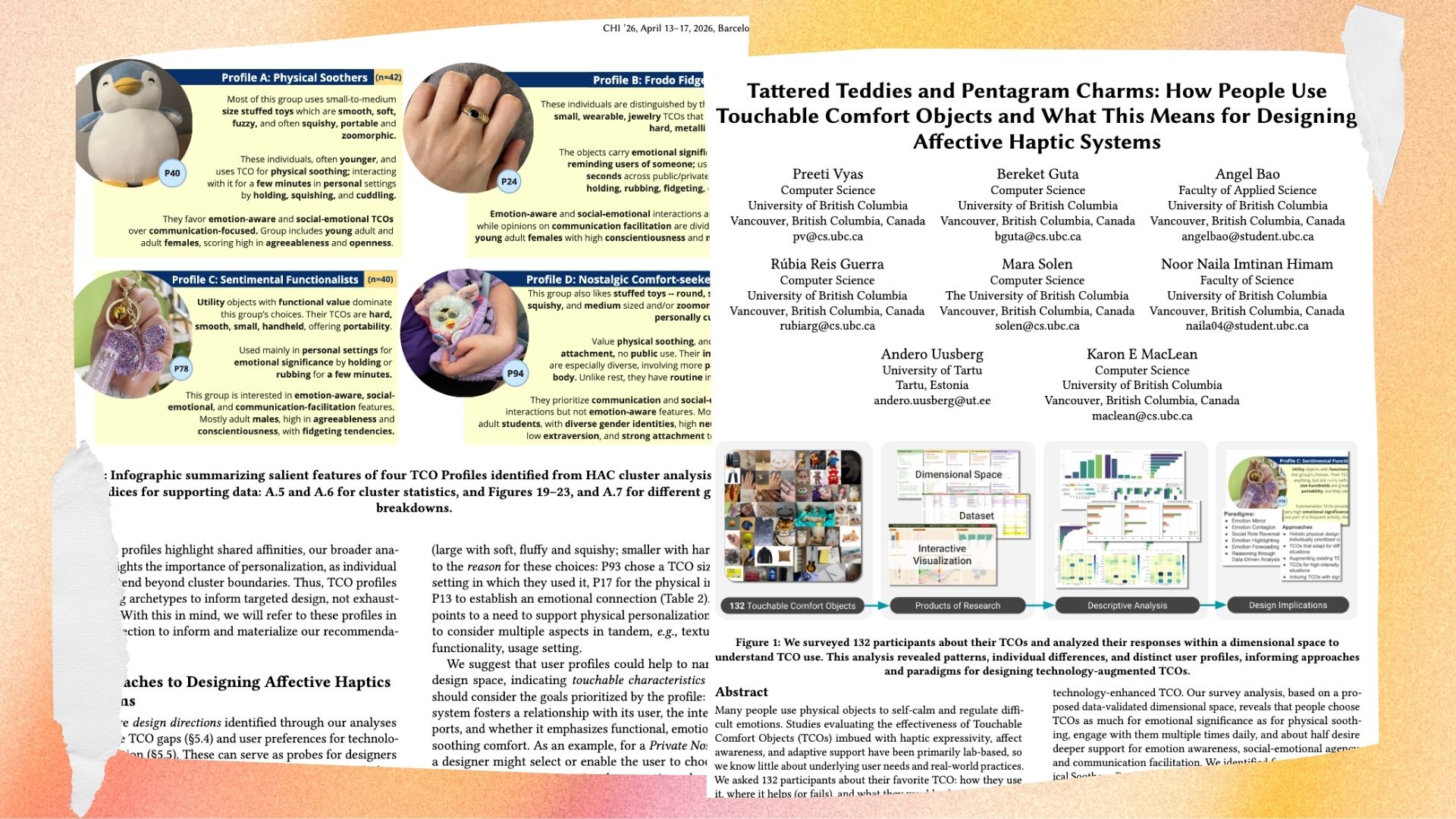
Published at ACM CHI 2026, where it received a Best Paper Award, this study moves Touchable Comfort Objects (TCOs), the teddy bears, charms, and keepsakes people use to self-soothe, out of the lab and into real life. Surveying 132 participants about their favorite comfort object, the work maps how people actually use these objects, where they help or fall short, and what people would value (or avoid) in a technology-enhanced version.
Authored with the UBC SPIN Lab. I contributed to data collection, qualitative analysis, writing the qualitative-analysis sections, and the data visualizations - including the dataset's interactive visualization.
People choose comfort objects as much for emotional significance as for physical soothing, and engage with them multiple times a day. The analysis - built on a data-validated dimensional space - identified four distinct user profiles: Physical Soothers, Frodo Fidgeters, Sentimental Functionalists, and Nostalgic Comfort-Seekers. About half of participants wanted deeper support for emotion awareness, social-emotional agency, and communication.
The paper contributes a dataset with an interactive visualization and a set of design opportunities for researchers and designers building affective haptic comfort technology.
132
Participants surveyed
4
User profiles identified
~50%
Wanted deeper emotional support
Qualitative Analysis
Coded survey responses and helped derive the four user profiles and the dimensional space underpinning them.
Data Collection
Supported gathering and organizing the 132-participant survey dataset.
Writing - Qualitative Analysis
Wrote and refined the qualitative-analysis sections, turning coded patterns into the paper's profiles and design implications.
Data Visualizations
Built figures and contributed to the dataset's interactive visualization that communicates how people relate to their comfort objects.
Survey-scale qualitative analysis
Practiced coding and synthesizing open-ended data across 132 participants into clear, design-relevant profiles.
Design-oriented research
Connected qualitative findings directly to design opportunities for affective haptic technology at a top-tier HCI venue (ACM CHI).