Digital Wellbeing · Mobile + Web
The Unfinished Project
A home for the songs, apps, essays and ideas you started and never finished, where each one is a letter to the project, and the right collaborator can help you finish it.
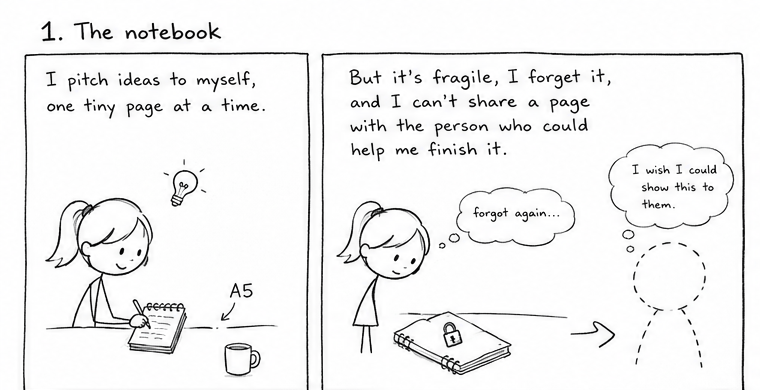
It started with an A5 notebook I keep forgetting at home
I carry an A5 notebook everywhere. It is where I pitch projects to myself, one tiny page at a time, and the smallness is the whole point. A page is too little room to be precious, so I just start. That constraint is generative, and, if I am honest, also genuinely annoying.
Because the book is fragile. I forget it at home on the exact day I have a good idea. The pages smudge. And the part that actually bothers me is that I cannot hand a single page to the one person who could help me finish what is on it. The idea stays trapped in a thing I own but cannot share.
The commute is the best creative time we have, and we hand it to the feed
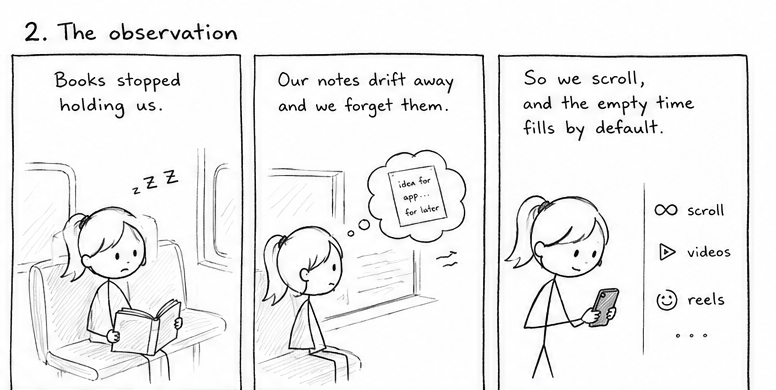
On the Jakarta MRT, on TransJakarta, on the SkyTrain back in Vancouver, I watch people scroll. Not because scrolling is fun anymore. You can see it on their faces. We got tired of books and games on the commute, and the feed fills the void by default, the way water finds the lowest point. That void is precious cognitive real estate, and we keep paving it over.
Researchers have a name for that empty, low-demand state, and it turns out to be the opposite of wasted. The blank rest of a commute is where the mind wanders, and mind wandering is where a lot of the good stuff quietly happens.
Baird and colleagues (2012) found that engaging in an undemanding task during an incubation period led to substantial improvements in performance on previously encountered creative problems, and that the improvement was associated with higher levels of mind wandering. Mann and Cadman (2014) went a step further and found that boring activities actually increased creativity, with daydreaming doing the quiet work in between.
Baird et al. (2012), Psychological ScienceSo the commute is not dead time. It is incubation time. The problem is that the feed is engineered to occupy exactly the state where your best half-thoughts want to surface. I did not want to build another thing to scroll. I wanted to build something that catches the half-thought before the feed swallows it.
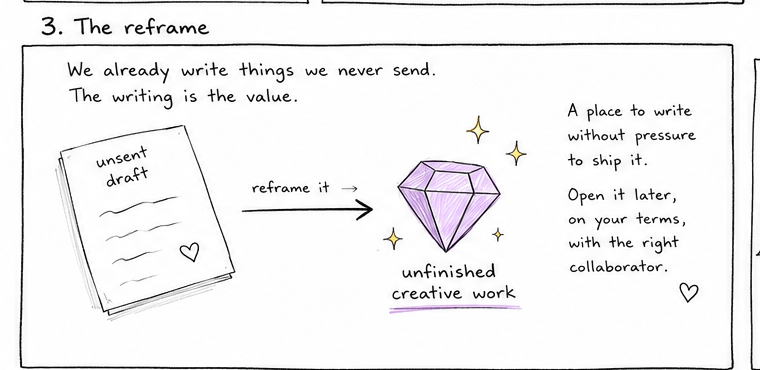
People already write things they never send. The writing is the value.
A CHI 2026 paper on unsent messages reframed something for me. We already do this. We write things we never send, and the not-sending is not a failure, it is the feature.
Yin and Xiao (2026) describe how unsent messages become expressive containers for suppressed feelings, where the act of writing creates a pause for reflection on the relationship and oneself. Across nine platform design variants, they show how the interface itself shapes the emotional, temporal, and ritual dimensions of what people are willing to write.
Yin and Xiao (2026), CHI, Honourable MentionThat landed for me. The writing, without the pressure of delivery, is the value. I wanted to take that affordance and point it at creative work instead of emotional containment. Not unsent messages. Unfinished projects. A place to write the thing down without the pressure to ship it, and a way to open it up later, on your terms, to the person who can help.
A home for the unfinished, that fits in the doomscroll slot
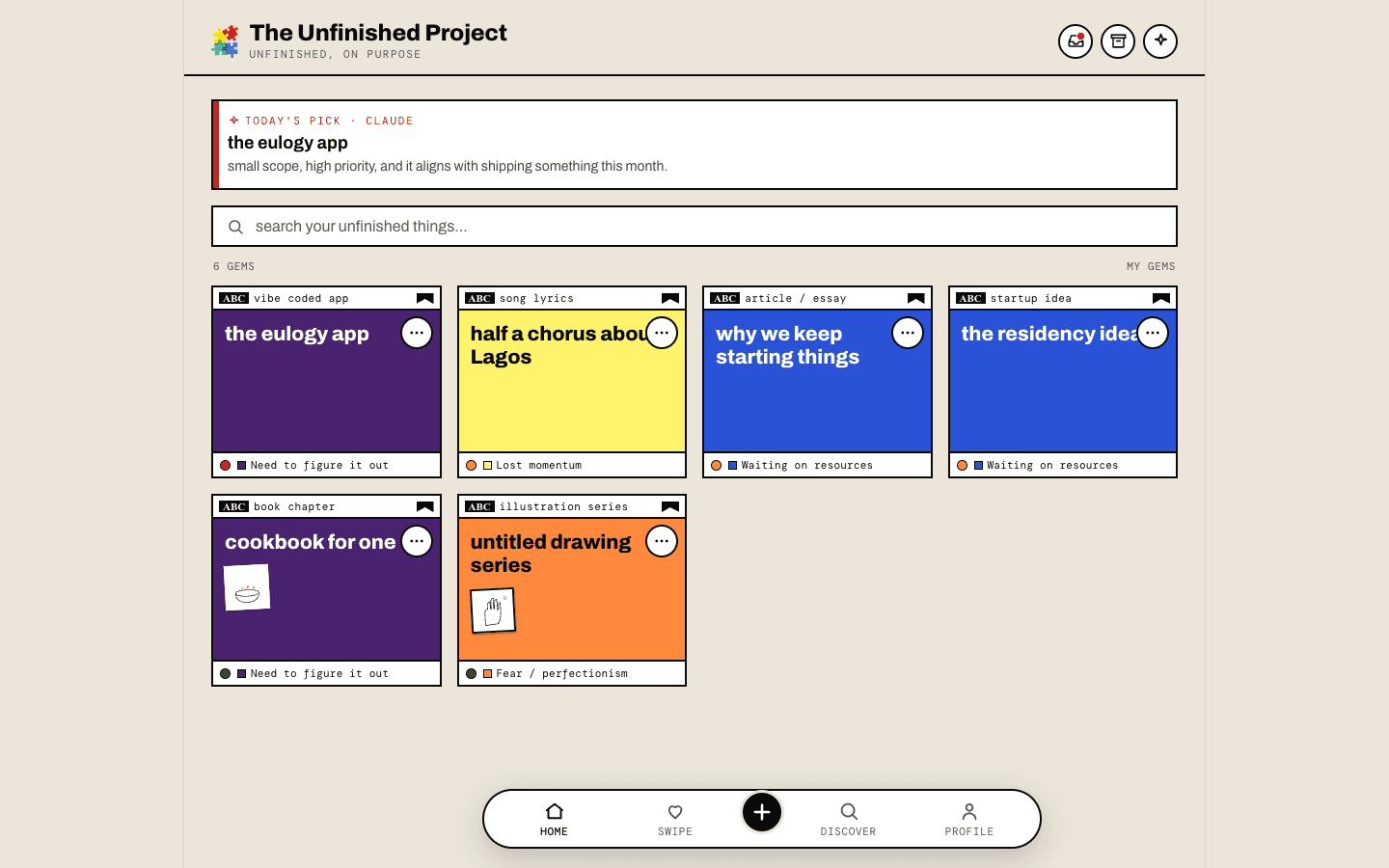
The Unfinished Project is a mobile and web app (Expo on the phone, Next.js on Vercel for the web, Supabase for data and auth, Claude for the thinking parts). Every unfinished thing is a gem, a colored letter addressed to the project. You log what it is, why it stopped, and what would help. It is meant to slot into the exact moment you would have opened the feed.
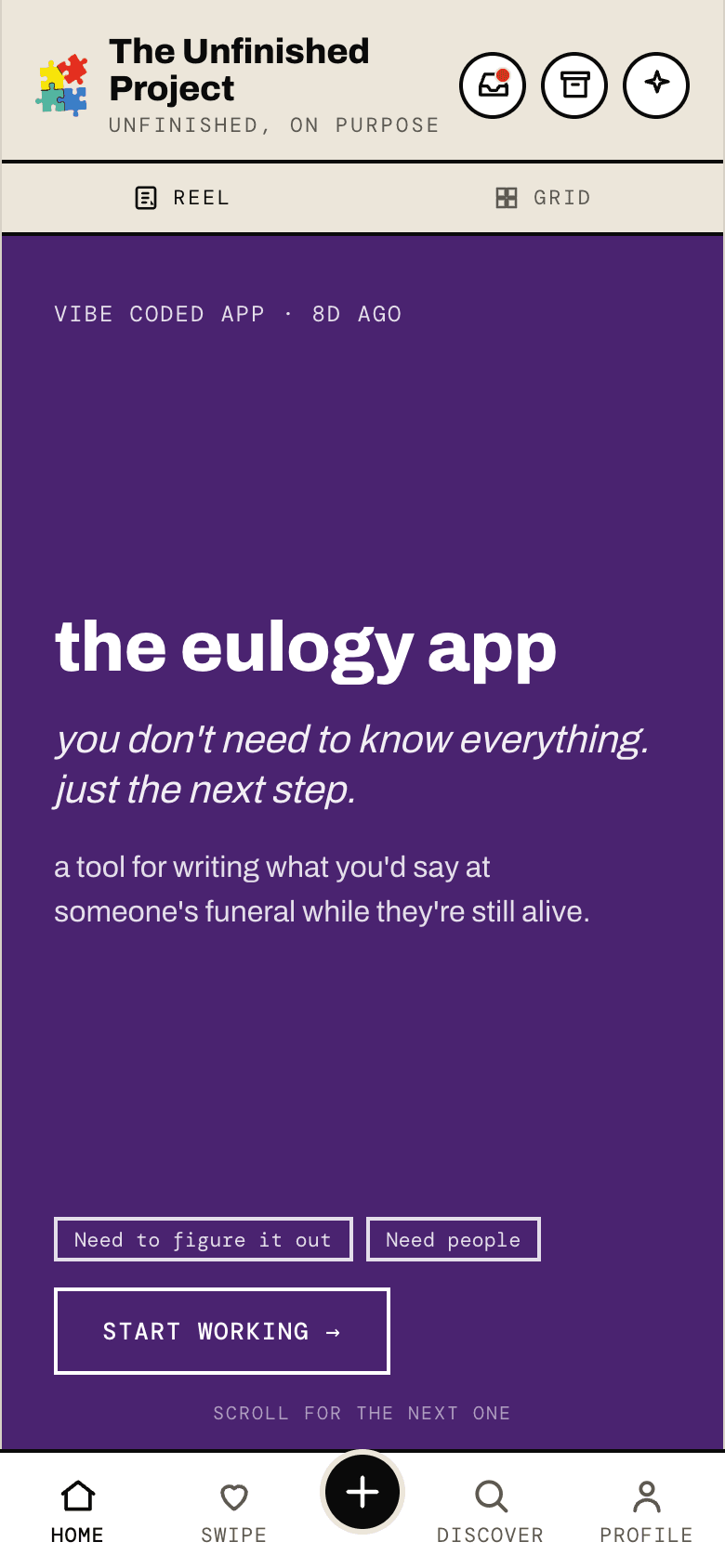
The biggest design call: scrolling cannot be a destination you click into, it has to be the thing that is there when you land. So Home itself is a vertical reel of your own gems, by default, the moment you open the app. One gem per screen, full bleed, in its stopper color, with the question it is waiting on. You scroll up to the next one, and the next one. You are doomscrolling, except every card is yours, and every card is a thread you abandoned, gently asking to be picked up.
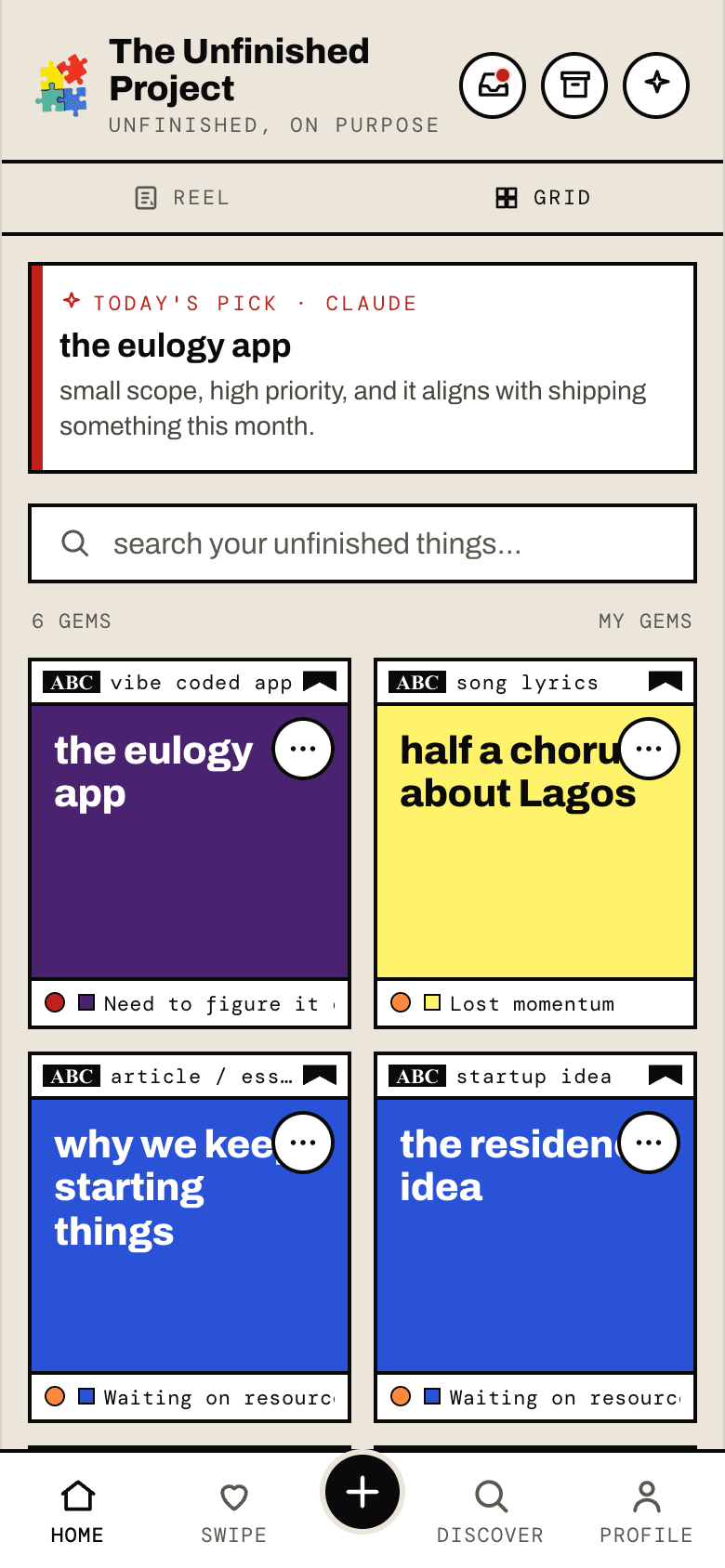
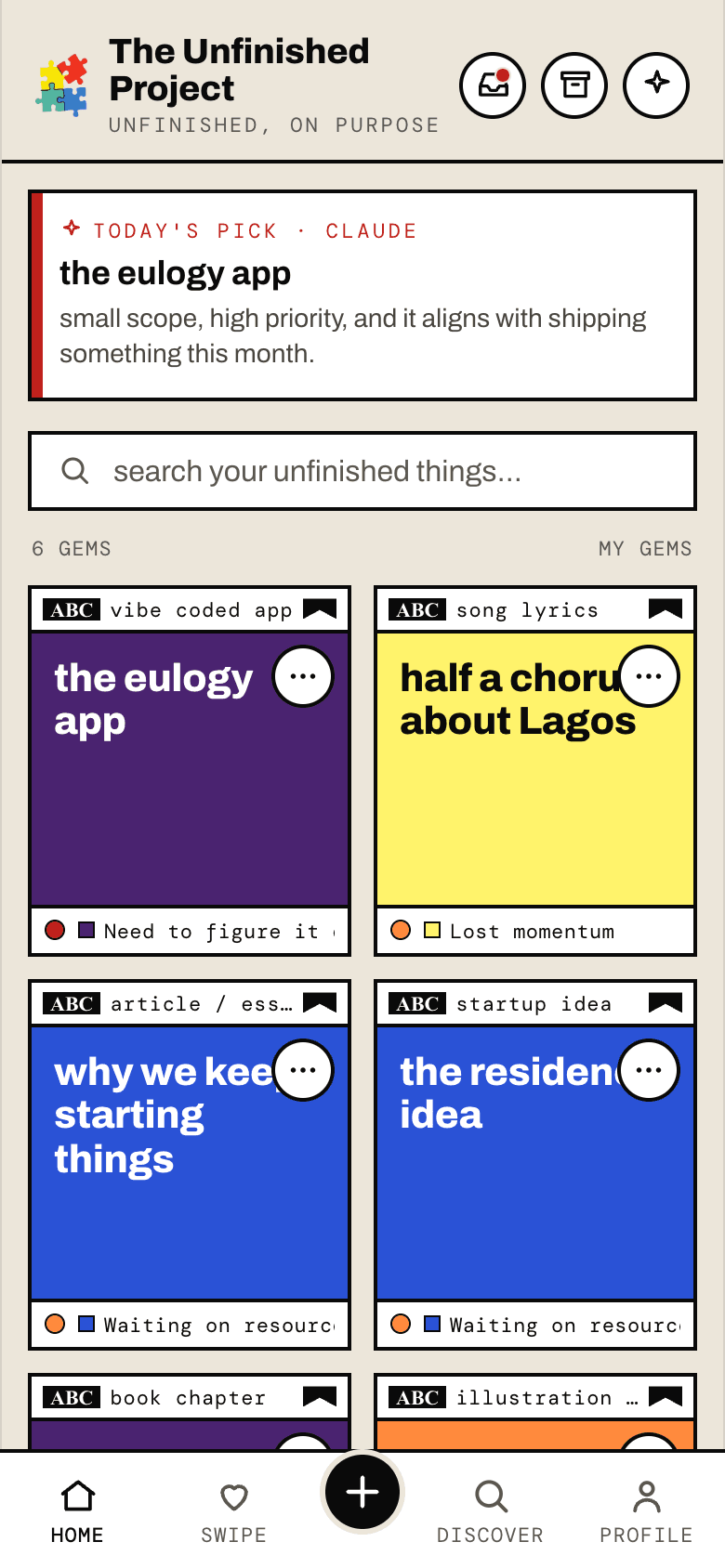
At the top of Home there is a small REEL / GRID toggle. The reel is for the doomscroll moment, the grid is for the I-need-to-find-something moment. Both views are Home. You never have to remember a tab name to get back to your gems, because your gems are the homepage. The same neural muscle that opened the feed now opens your shelf.
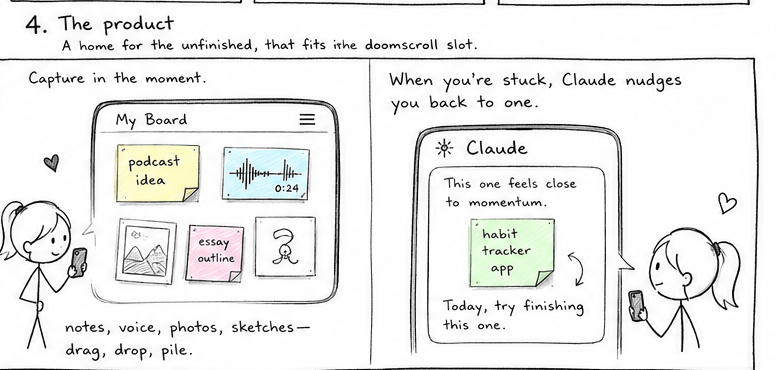
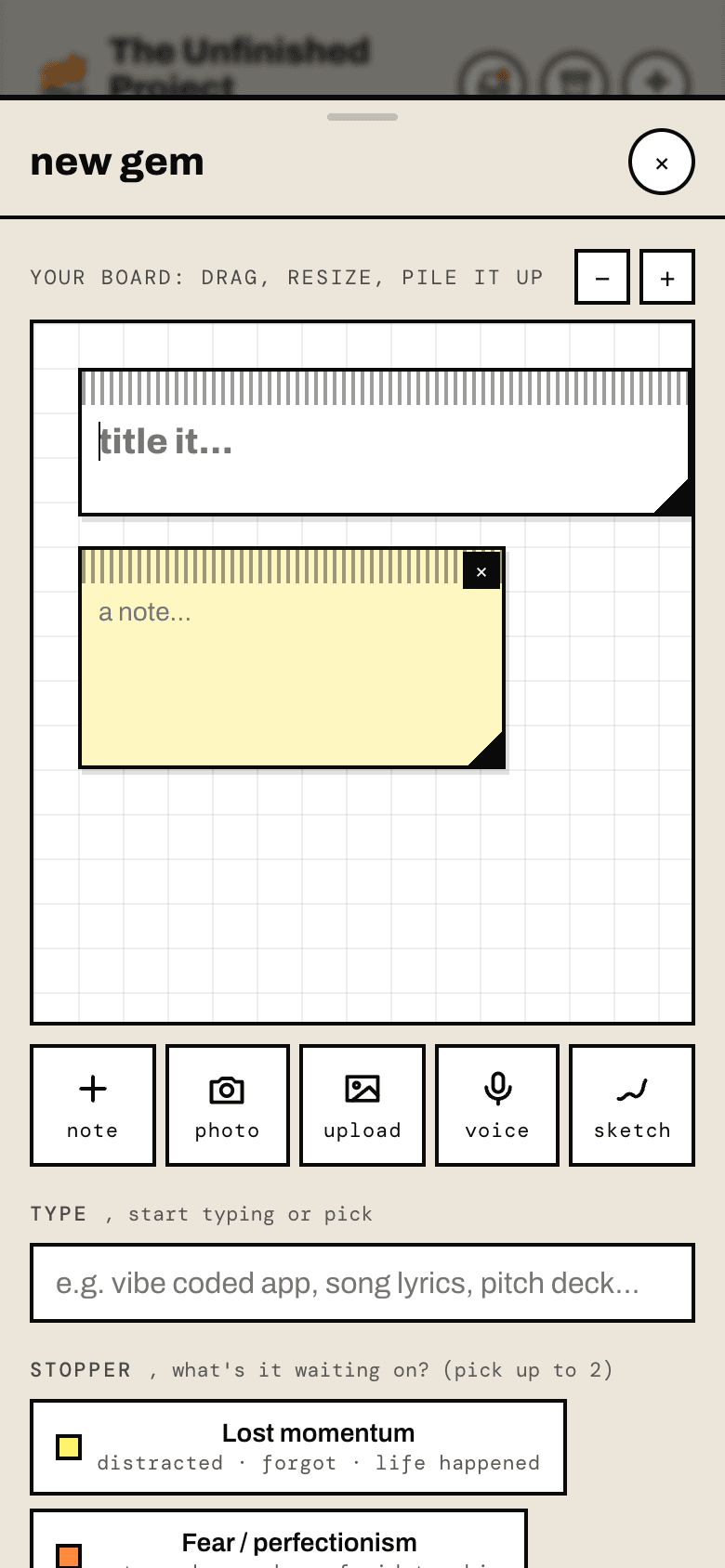
Capture is a Miro-style board, not a form. You drop notes, photos, a camera shot, a voice memo with live transcription, or a quick sketch, then drag, resize, and pile them up. The friction is deliberately near zero, because the whole bet is that you do this on a moving train with one thumb. Each gem gets tagged with its stopper, the honest reason it stalled, like lost momentum, fear and perfectionism, or waiting on resources.
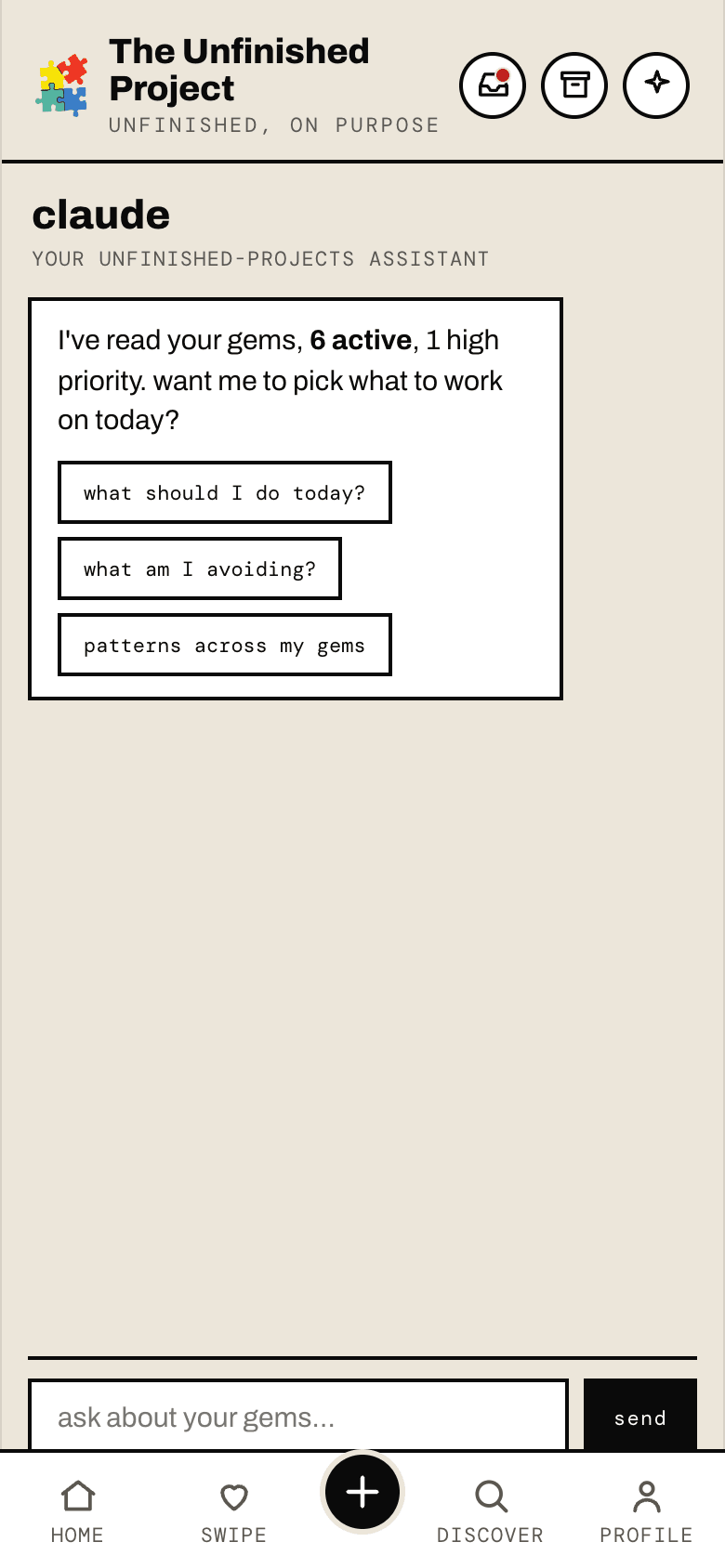
Then there is the part I am most attached to. Claude reads across all your gems and acts like a patient studio mate. You can ask what should I do today, what am I avoiding, or show me the patterns across my gems. It can draft the next small steps for a gem so the restart cost is a tap, not a sigh. It is the difference between a notebook that just holds your ideas and one that gently nudges you back to them.
Keep it private, or hand one page to the right person
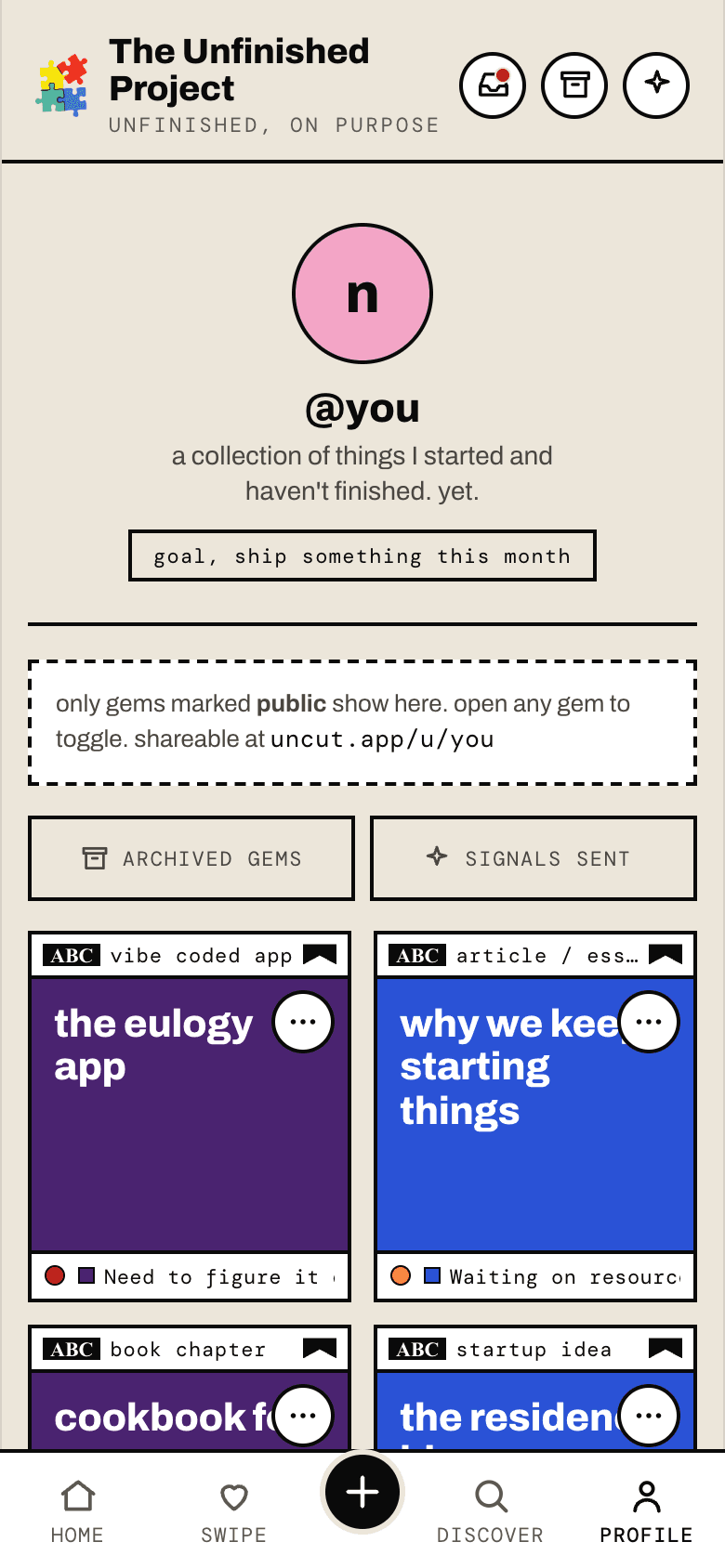
By default a gem is yours alone. That is the A5 notebook replacement, the private shelf. But the thing my paper notebook could never do is let me hand a single page to someone who could help. So you can make one specific gem public through your own /u page, choosing exactly what the world sees, while the messy board behind it stays private.
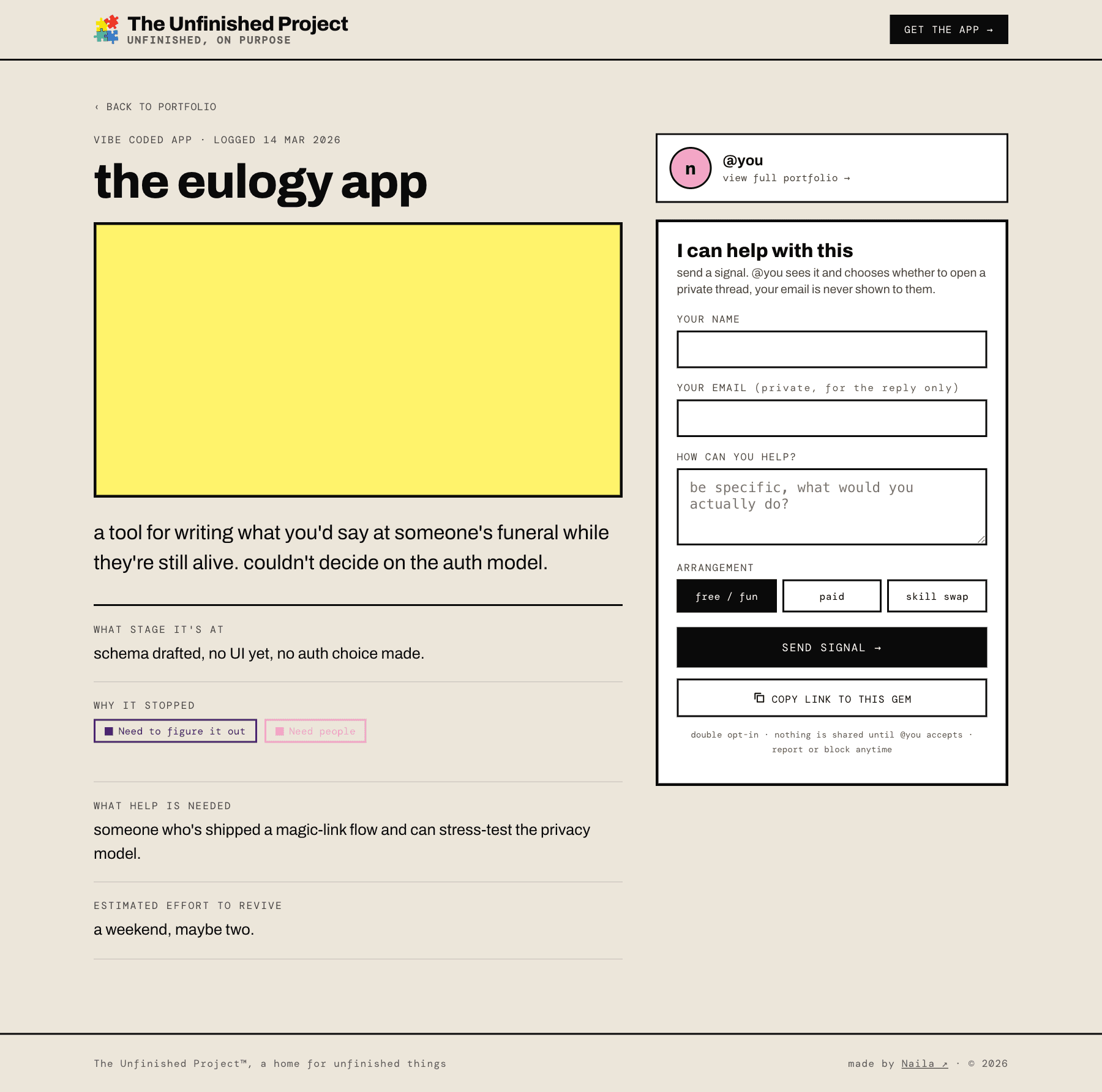
Someone who sees your gem can leave an I can help note. Here is the rule I cared about most: it is double opt-in. A signal only becomes a private in-app thread after you accept it, and your email is never handed over, it is only ever used to notify you. No cold contact, no exposed inbox. Help is offered, not forced.
And because finding the right person is half the battle, there is a swipe deck of public gems that Claude thinks you could actually help finish, plus a discover view to search for people and projects to collaborate with. It is the matchmaking layer for unfinished work, built on the same careful, consent-first plumbing.
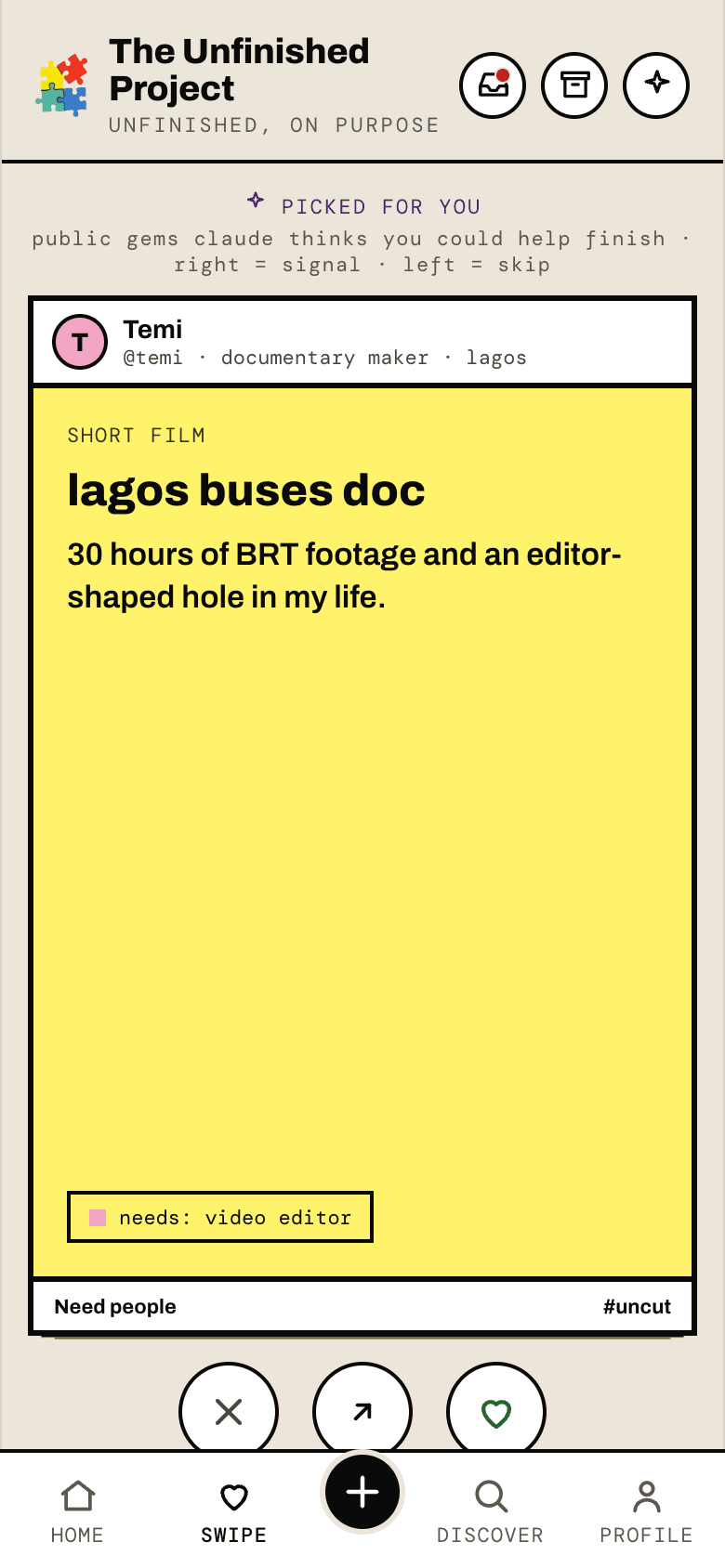
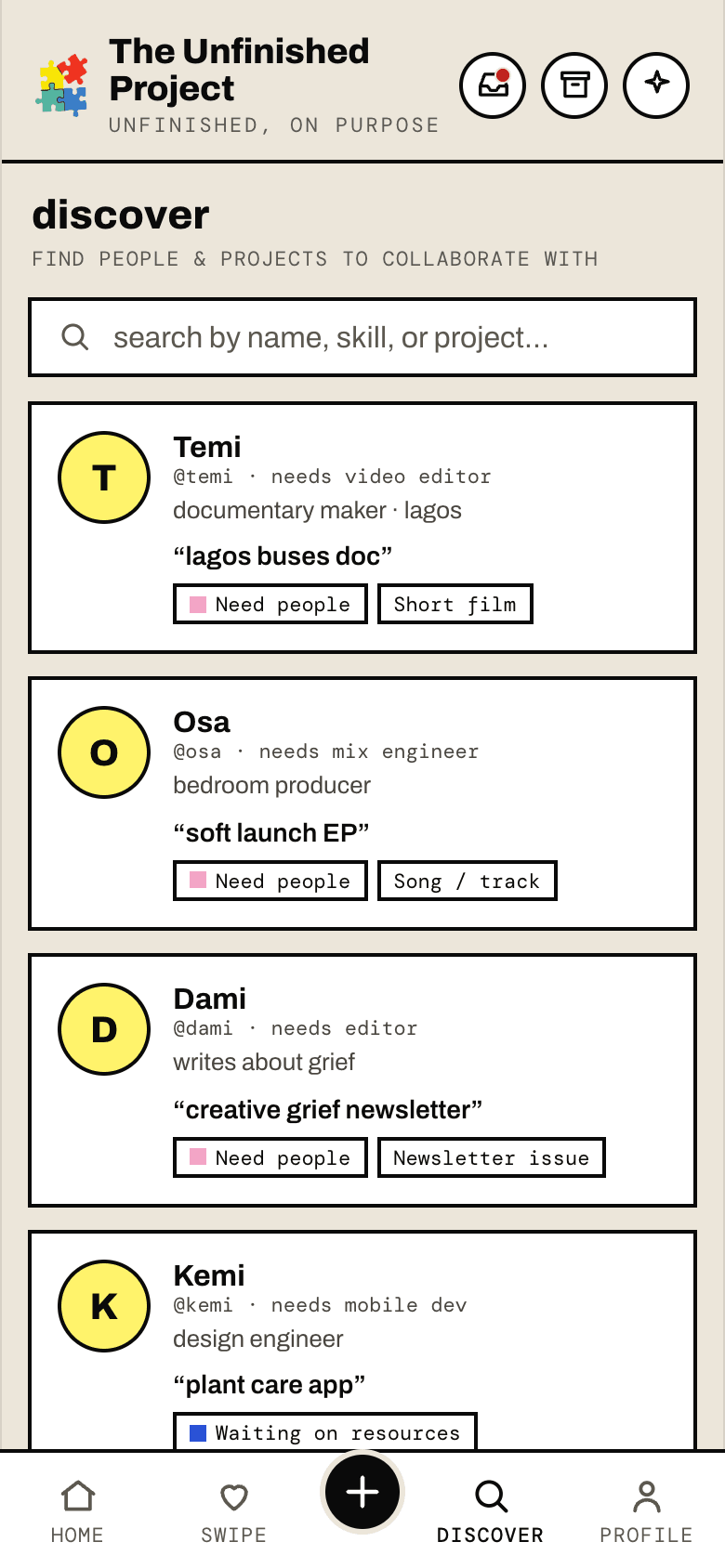
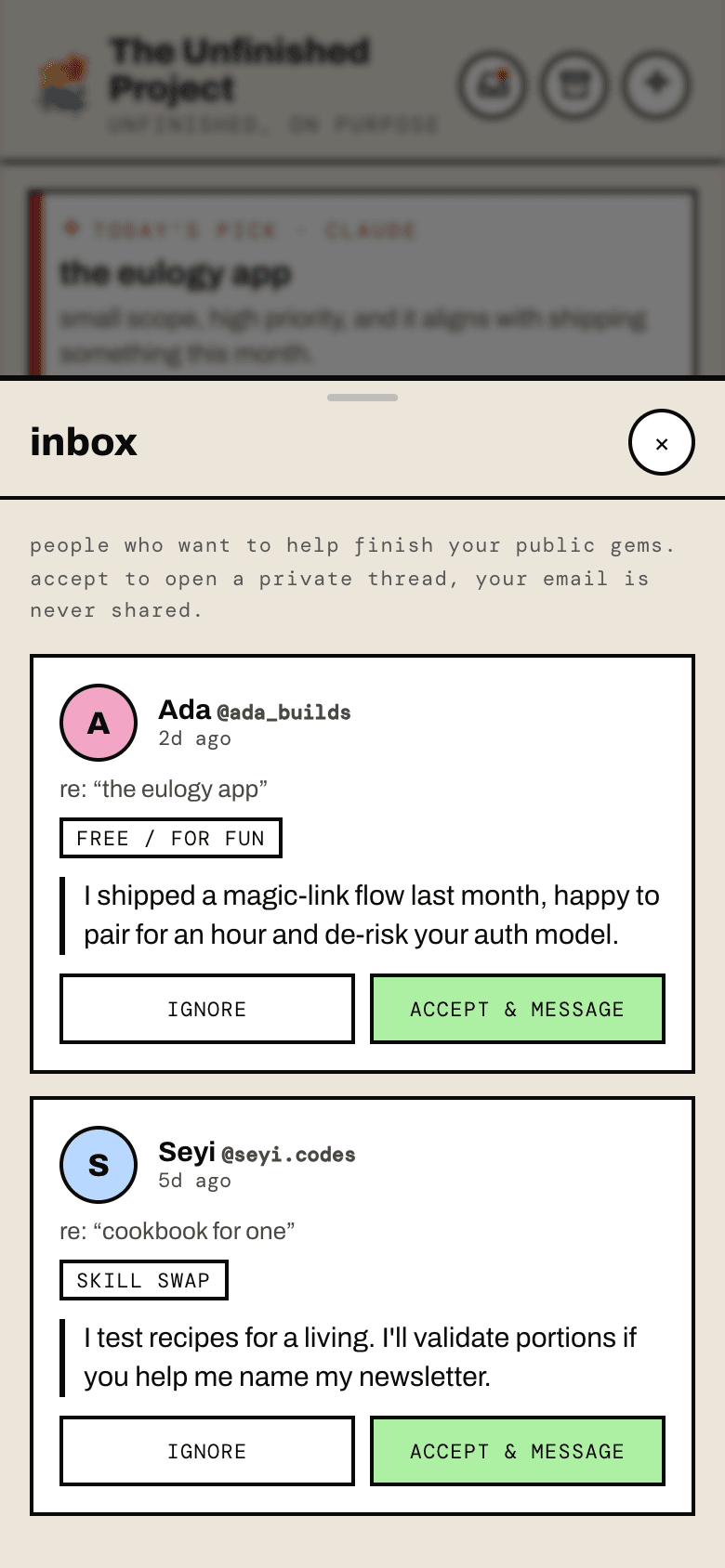
The one I am proudest of right now
This is the project I am proudest of right now, because it sits exactly where three parts of my life overlap. There is my HCI research background (the SPIN Lab, affective computing, the CHI 2026 honourable mention), which taught me to design for feelings and not just tasks. There is the digital wellbeing concept I have been developing for the Southeast Asian market, where the commute and the feed are a daily, shared reality. And then there is the deeply personal part, my notebook, the fragile little book I keep forgetting at home.

The Unfinished Project is my attempt to give that notebook a backup, a brain, and a door. It replaces doomscroll time with low-friction creative capture, it remembers the things you meant to come back to, and when you are ready, it lets exactly one page out to exactly the right person. Unfinished, on purpose.