Affective Computing · IEEE 2026
Affiliative Touch & Emotion Regulation
A theory-driven study of how lifelike, affiliative touch helps people regulate emotion
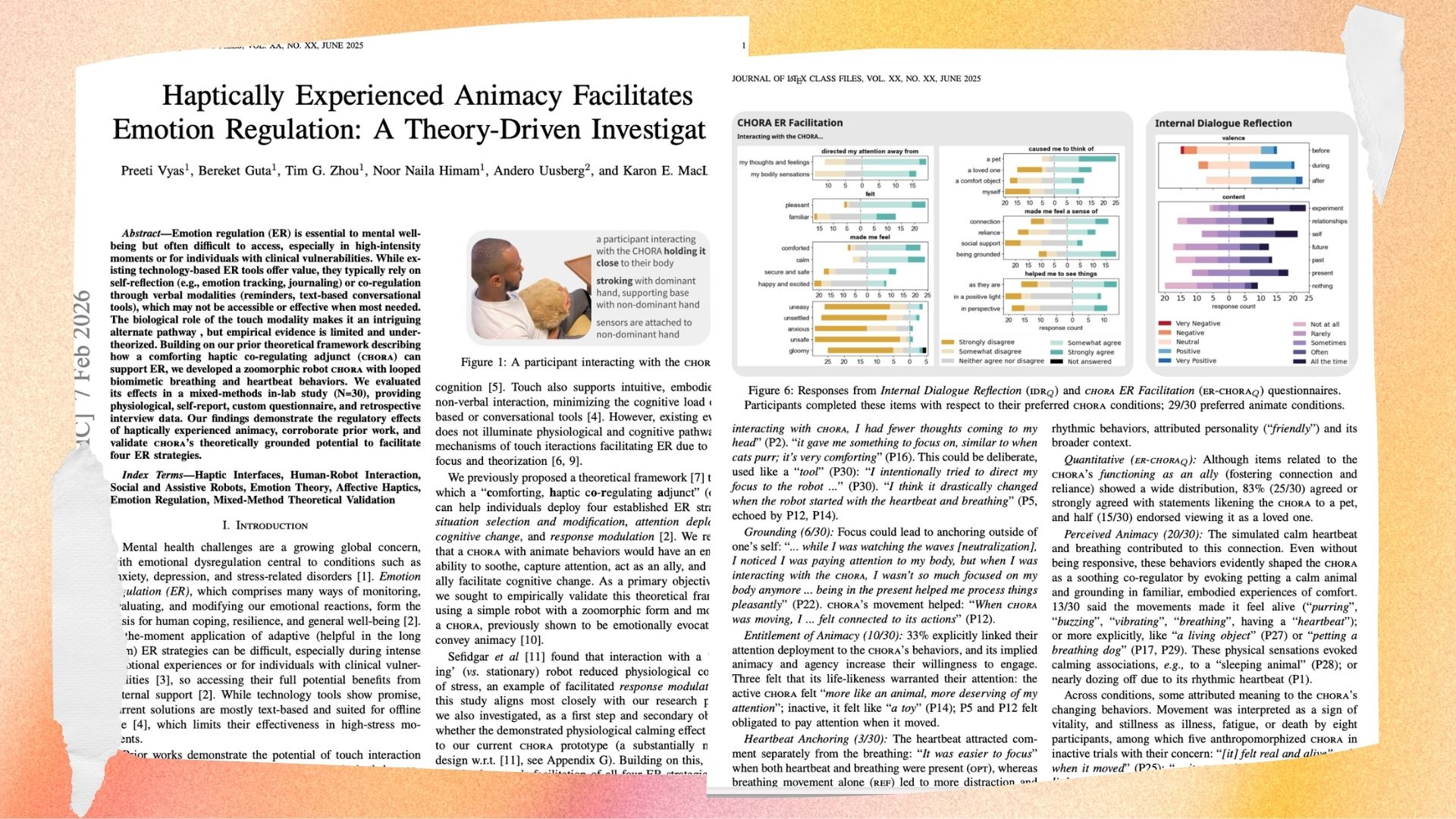
Published in IEEE Transactions on Affective Computing (2026), this theory-driven investigation examines how touch that is experienced as 'alive' - what the paper calls haptically experienced animacy - through affiliative, affectionate contact can facilitate emotion regulation. The work grounds affective haptic design in psychological theory, connecting the felt sense of a touch being warm and responsive to its power to help people manage difficult emotions.
Authored with the UBC SPIN Lab (Vyas, Guta, Zhou, Himam, Uusberg, MacLean). I joined as the 4th author, contributing to data collection, qualitative analysis, the writing of the qualitative sections, and the data visualizations.
Qualitative Analysis
Coded and synthesized participants' open-ended responses, helping surface the themes that connect felt animacy to emotion-regulation outcomes.
Data Collection
Supported running the study and gathering participant data used in the theory-driven analysis.
Writing - Qualitative Analysis
Drafted and refined the qualitative-analysis portions of the manuscript, translating coded themes into the paper's narrative.
Data Visualizations
Produced figures and visualizations that communicate the relationships between affiliative touch, animacy, and emotion regulation.
Theory-driven affective computing
Learned to anchor haptic interaction findings in established emotion-regulation theory rather than ad-hoc interpretation.
Contributing to a peer-reviewed journal
Experienced the full arc of a journal publication - from coding data to writing and revising for IEEE Transactions on Affective Computing.