Environmental Psychology
Urban Biodiversity & Emotion in Jakarta
Research proposal on biodiversity exposure and mental health in a Global South megacity
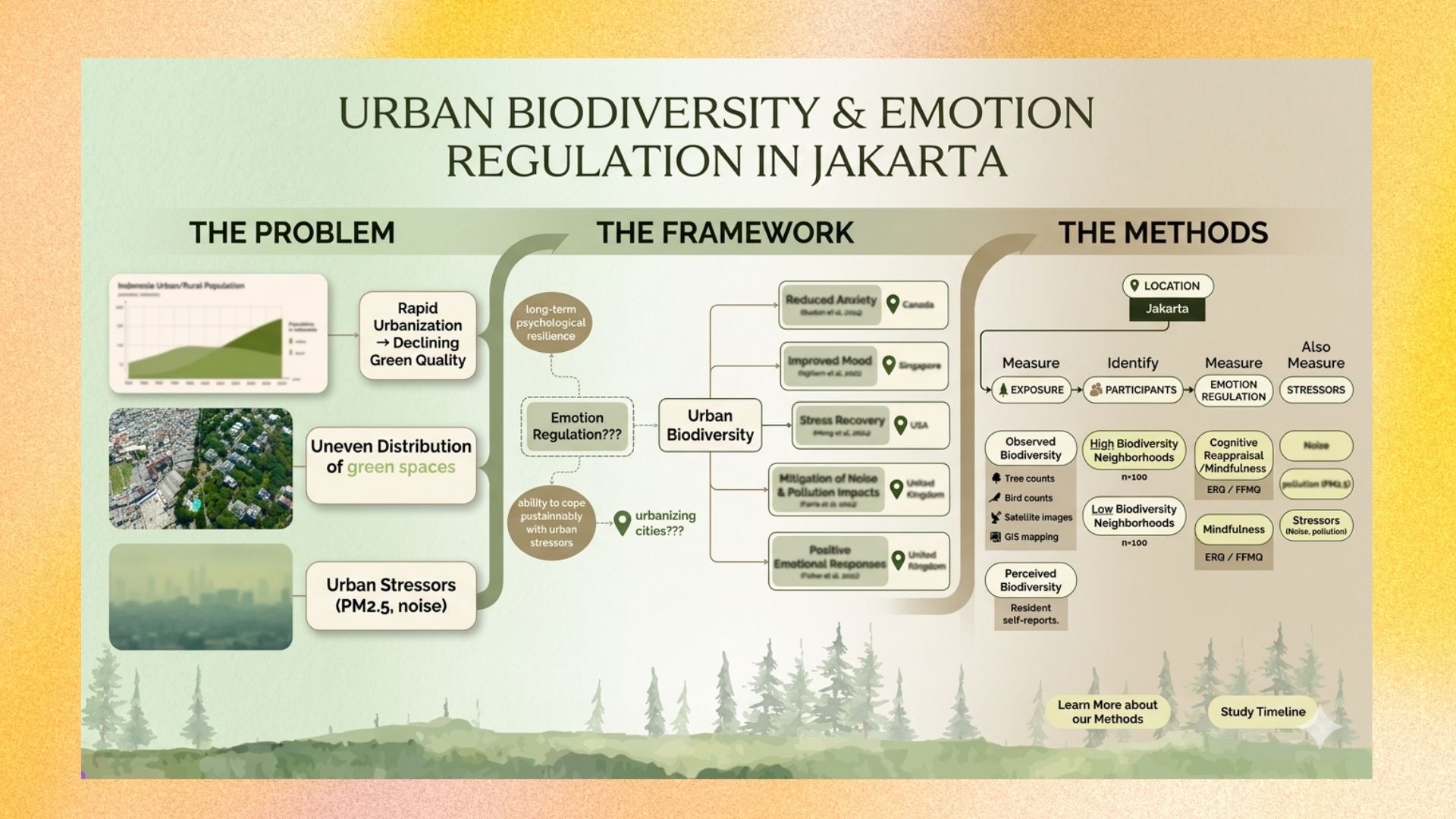
This research proposal examines the relationship between urban biodiversity exposure and emotion regulation strategies - specifically cognitive reappraisal and mindfulness - in Jakarta, Indonesia. The study compares high- and low-biodiversity neighborhoods, investigating both perceived and actual biodiversity while controlling for urban stressors like pollution, noise, and crowding. It aims to inform urban planning and nature-based mental health interventions in Global South cities.
Most research on nature and mental health comes from Western, high-income countries. Jakarta - a megacity of 10+ million with pressing mental health concerns and rapidly shrinking green spaces - represents a critically understudied context. Existing studies also tend to measure objective biodiversity (species counts) rather than perceived biodiversity (what people actually notice and experience), potentially missing the psychological mechanism through which nature affects well-being.
200
Planned participants (stratified sampling)
3
Hypotheses tested
10M+
Jakarta population
Site Selection
Site Selection
Identify high- and low-biodiversity districts in Jakarta using satellite imagery and existing ecological surveys. Control for socioeconomic status across sites.
Observed Biodiversity
Observed Biodiversity
Measure actual biodiversity through field counts, satellite imagery analysis, and GIS mapping of green spaces within participant neighborhoods.
Perceived Biodiversity
Perceived Biodiversity
Administer questionnaires measuring participants' subjective experience of nature variety and abundance in their daily environments.
Emotion Regulation
Emotion Regulation
Assess cognitive reappraisal using the Emotion Regulation Questionnaire (ERQ) and mindfulness using the Five Facet Mindfulness Questionnaire (FFMQ).
Urban Stressors
Urban Stressors
Measure noise (decibel meters), air pollution (PM2.5 sensors), and population density as potential mediating variables.
Analysis
Analysis
Use ANOVA for group comparisons, multiple regression for predictive relationships, and mediation analysis to test whether urban stressors dampen biodiversity-emotion regulation links.
H1: Higher perceived biodiversity is linked to greater use of cognitive reappraisal and mindfulness strategies
H2: Perceived biodiversity will show a stronger connection to emotion regulation than objectively observed biodiversity
H3: Urban stressors (noise, pollution, crowding) will weaken the association between biodiversity and emotion regulation
Jakarta offers a unique research context: extreme urban density, significant socioeconomic stratification, pressing mental health challenges, and dramatic variation in green space access across neighborhoods. Unlike Western cities where most nature-mental health research is conducted, Jakarta represents the lived reality for billions of people in rapidly urbanizing Global South megacities. Findings here could directly inform green infrastructure investment and community mental health programs.
Perceived vs. observed biodiversity
If H2 is supported, it would shift the focus of urban greening initiatives from maximizing species counts to designing spaces that feel biodiverse to residents - a potentially more cost-effective approach.
Global South evidence base
Contributing empirical data from a non-Western megacity addresses a critical gap in environmental psychology literature that currently over-represents European and North American contexts.
Actionable urban planning insights
Results would directly inform Jakarta's green infrastructure investment decisions, helping prioritize which neighborhoods and what types of greening interventions would most benefit mental health.
Nature-based mental health interventions
Understanding the biodiversity-emotion regulation link could support therapeutic programs that use structured nature exposure as a complement to traditional mental health treatment.