Science Communication
UBC iGEM Wiki: Designing for Synthetic Biology
Designing a competition wiki that makes complex biosynthesis research approachable
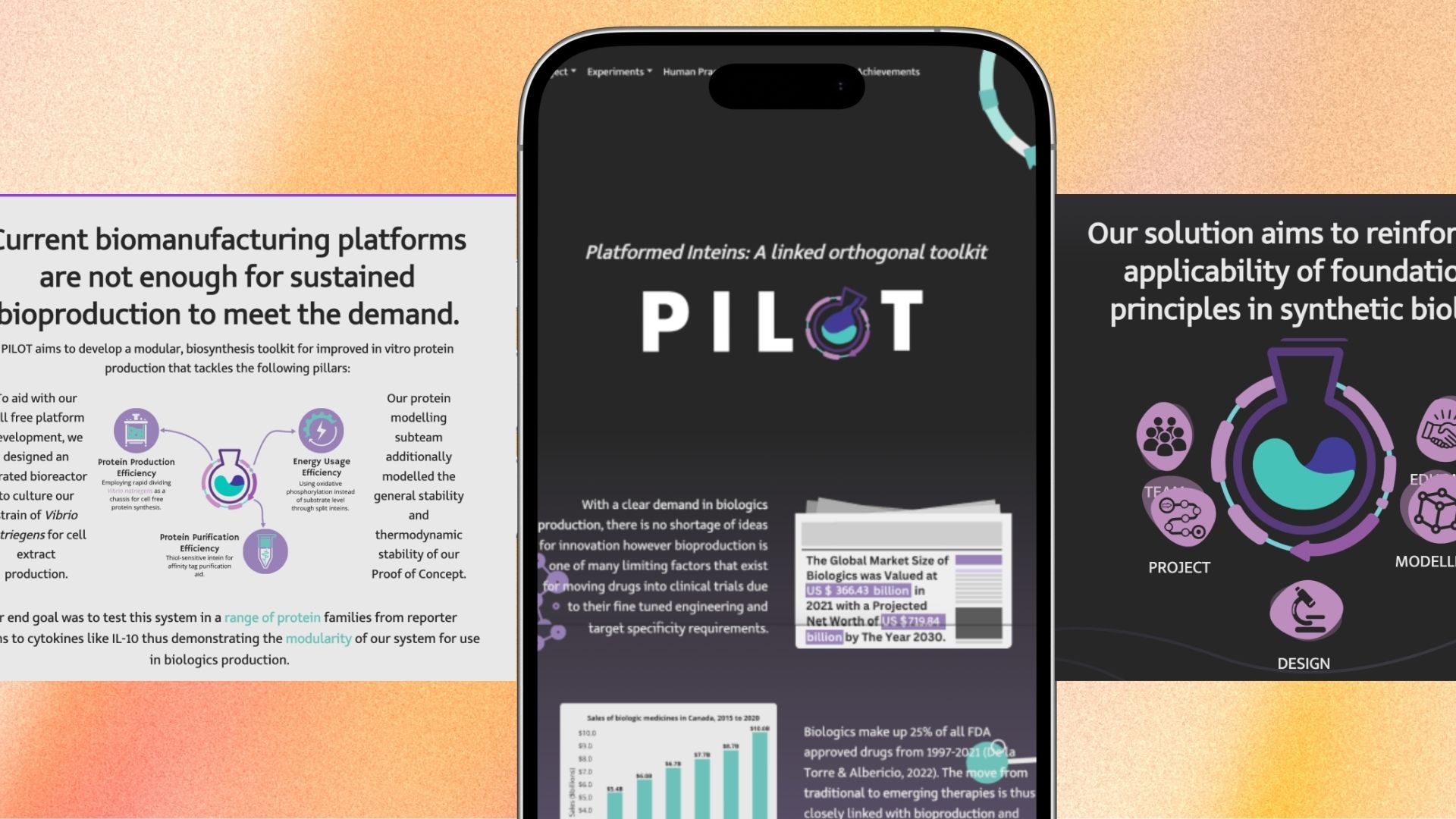
I designed the 2023 UBC iGEM competition wiki website for PILOT (Platformed Inteins: A Linked Orthogonal Toolkit) - a modular biosynthesis system for improving in vitro protein production. The challenge was translating dense synthetic biology research into an engaging, navigable web experience that could communicate the science to both judges and the general public.
iGEM wikis must present months of complex research - from molecular biology protocols to mathematical modeling - in a way that's both scientifically rigorous and visually engaging. PILOT involved cell-free protein synthesis, intein engineering, and bioreactor design. The wiki needed to serve multiple audiences: expert judges evaluating scientific depth, other iGEM teams looking for collaboration, and the public wanting to understand the project's real-world impact.
3
Efficiency pillars to communicate
10+
Wiki pages designed
2
Audiences: judges & public
Content Audit
Understanding the Science
Worked closely with the wet lab, dry lab, and human practices teams to understand PILOT's three efficiency pillars: protein production, energy usage, and protein purification through intein engineering.
Info Architecture
Structuring Complex Content
Organized the wiki into logical sections that follow the research narrative - from problem statement through methodology to results. Created clear navigation between interconnected topics.
Visual Design
Making Science Visual
Developed a visual language that balanced scientific accuracy with approachability. Used illustrations, diagrams, and consistent color coding to make molecular concepts tangible.
Implementation
Building the Wiki
Translated designs into the iGEM wiki framework, ensuring responsive layouts, accessible typography, and smooth navigation across all pages.
Review & Polish
Team Review & Iteration
Conducted review sessions with the full team to verify scientific accuracy of visual representations and ensure all content was properly integrated.
Visual metaphors for molecular concepts - making intein self-cleavage and cell-free synthesis understandable through diagrams rather than text alone
Progressive disclosure - allowing readers to explore high-level summaries before diving into technical protocols
Consistent color-coded sections matching PILOT's three efficiency pillars for easy navigation
Mobile-responsive layouts ensuring the wiki is accessible on any device during the competition jamboree
Science communication through design
Translating cell-free protein synthesis and intein engineering into visual narratives taught me how design can bridge the gap between expert knowledge and public understanding.
Designing for dual audiences
Balancing scientific rigor for judges with approachability for the public required a layered information architecture - summary first, then detail on demand.
Cross-disciplinary collaboration
Working with biologists, engineers, and modelers across the iGEM team taught me how to extract visual stories from highly technical research.
Design under competition constraints
iGEM wikis have strict technical constraints (wiki framework, URL structure). Designing creatively within those limitations pushed my problem-solving skills.