Cognitive Psychology · ISEF 2021
Working Memory & Binaural Beats
Optimizing working memory capacity with binaural beats: an experimental study on high school students
This experimental study investigated whether binaural beats can enhance working memory capacity in high school students. We recruited 64 participants across four groups (3 experimental + 1 control) and measured their working memory using the Automated Operation Span (Aospan) Task before and after exposure to alpha, beta, and gamma binaural beats. The study was conducted during the COVID-19 pandemic when online learning amplified the need for cognitive optimization tools.
Beta binaural beats (20 Hz) produced the most significant improvement in working memory capacity (p = 0.001), with an average Aospan score increase of 11.063 points. The study earned both a Special Award and a Grand Award at ISEF (International Science and Engineering Fair).
The COVID-19 pandemic forced most schools into online learning, significantly impacting student performance. Students reported reduced focus, information overload, and digital distractions. Working memory, the cognitive system responsible for holding and processing information during learning, is essential for reading comprehension, problem-solving, and task completion. We wanted to explore a non-invasive, accessible method to enhance this capacity.
6h 40m
Daily screen time average for students
64
Participants across 4 experimental groups
25%
Effectiveness of binaural beats on Aospan score
Do alpha, beta, and gamma binaural beats have a significant effect on high school students' working memory capacity?
Literature
Literature Review & Gap Analysis
Reviewed existing research on binaural beats and working memory. Found that while prior studies (Kraus & Purabanova, 2015) showed effects on university students, the impact on younger populations remained unexplored. We also examined alpha, beta, and gamma frequency research to design a comprehensive multi-frequency study.
Study Design
True Experimental Design
Designed a pretest-posttest control group experiment with four groups (alpha, beta, gamma, control). Used stratified random sampling with a 1:1 gender ratio across all groups. Each group had 16 participants (8 male, 8 female).
Instruments
Automated Operation Span (Aospan) Task
Selected the Aospan Task as our measuring instrument, a validated working memory indicator with high internal consistency and test-retest reliability (Klein & Fiss, 1999). Prepared binaural beat audio stimuli at three frequencies: alpha (11 Hz), beta (20 Hz), and gamma (40 Hz).
Ethics
IRB Approval & Consent
Obtained experimental protocol approval from the Institutional Review Board (IRB) of the Society for Science. Collected electronic informed consent and parental consent for all underage participants before data collection began.
Collection
Online Data Collection
Conducted all data collection online via video conference due to pandemic restrictions. Participants completed the Aospan pretest, received 15 minutes of binaural beats exposure (or muted audio for control), then completed the Aospan posttest. Data collection spanned five days based on participant availability.
Analysis
Mixed-Design ANOVA
Processed data using SPSS with descriptive statistics, normality tests (Shapiro-Wilk), homogeneity tests (Levene), and two-way mixed-design ANOVA. Compared between-groups (binaural beat types) and within-groups (pretest vs. posttest) variances.
ISEF
International Presentation & Awards
Presented findings at ISEF (International Science and Engineering Fair), earning both a Special Award and Grand Award. The study demonstrated the practical applicability of binaural beats for student learning optimization.
True Experimental Design with Pretest-Posttest Control Group pattern. Two independent variables: group (alpha/beta/gamma/control) and time (pretest/posttest). Dependent variable: working memory capacity measured by Aospan score.
Procedure
- 1Recruited 64 participants via stratified random sampling (1:1 gender ratio)
- 2Assigned 48 to experimental groups (16 each) and 16 to control group
- 3Administered Aospan pretest to all groups via video conference
- 4Exposed experimental groups to 15 min of binaural beats (alpha 11 Hz, beta 20 Hz, or gamma 40 Hz)
- 5Control group received identical video with muted audio
- 6Administered Aospan posttest immediately after exposure
Aospan Score
Primary DV · Automated Operation Span Task score measuring working memory capacity
Group Assignment
Between-subjects IV · Alpha (11 Hz), Beta (20 Hz), Gamma (40 Hz), or Control (muted)
Time
Within-subjects IV · Pretest vs. posttest Aospan scores
Normality
Assumption Check · Shapiro-Wilk test (all groups p > 0.05)
Homogeneity
Assumption Check · Levene test for equal variances
Mean Aospan Score Change (Posttest - Pretest)
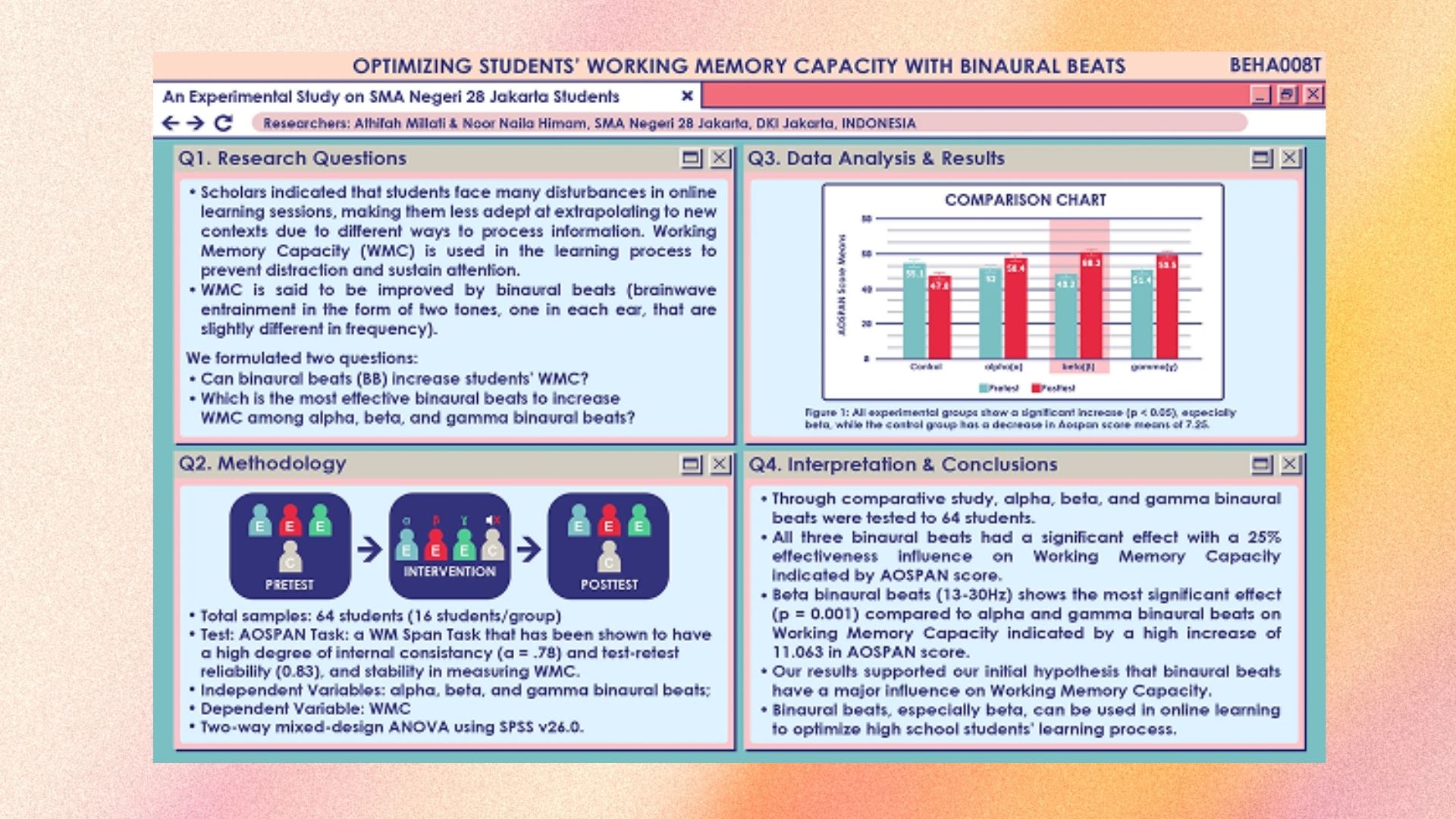
Beta binaural beats (20 Hz) had the most significant effect with an average score increase of 11.063 points (p = 0.001). All three experimental groups showed significant improvements compared to the control group, which actually decreased by 7.25 points. The overall effectiveness of binaural beats was 25% (partial eta squared = 0.251).
Mean Aospan Scores: Pretest vs. Posttest
The control group showed a decrease in Aospan scores from pretest (M = 55.1) to posttest (M = 47.8), possibly due to test fatigue without cognitive stimulation. In contrast, beta binaural beats increased scores from 49.2 to 60.3, the largest improvement across all groups.
Novel Population
First study to test binaural beats on high school students (ages 15-17), extending prior research that focused only on university students.
Multi-Frequency Comparison
Simultaneously compared alpha, beta, and gamma binaural beats in a single controlled experiment, providing direct frequency comparison data.
Beta Frequency Superiority
Established beta binaural beats (20 Hz) as the most effective frequency for enhancing working memory, with the largest score increase (11.063 points).
Pandemic-Era Application
Demonstrated a practical, non-invasive tool for enhancing cognitive performance during online learning, directly applicable to the COVID-19 educational context.
Robust Methodology
Used IRB-approved true experimental design with stratified random sampling and validated instruments (Aospan Task), ensuring high internal validity.
Literature Gap Identification
Identified that existing binaural beats research focused on university students and single frequencies. Saw an opportunity to test multiple frequencies on younger participants.
Study Design & IRB Approval
Designed a true experimental study with four groups. Secured IRB approval from the Society for Science and collected informed consent from all participants and parents.
Pilot & Calibration
Tested the Aospan Task delivery via video conference. Calibrated binaural beat audio stimuli at alpha (11 Hz), beta (20 Hz), and gamma (40 Hz) frequencies.
Data Collection (Online)
Conducted the full experiment online across five days. Managed 64 participants remotely via WhatsApp coordination and video conference sessions.
ISEF Presentation & Awards
Presented findings at the International Science and Engineering Fair. The study earned both a Special Award and Grand Award, validating the significance and rigor of our research.
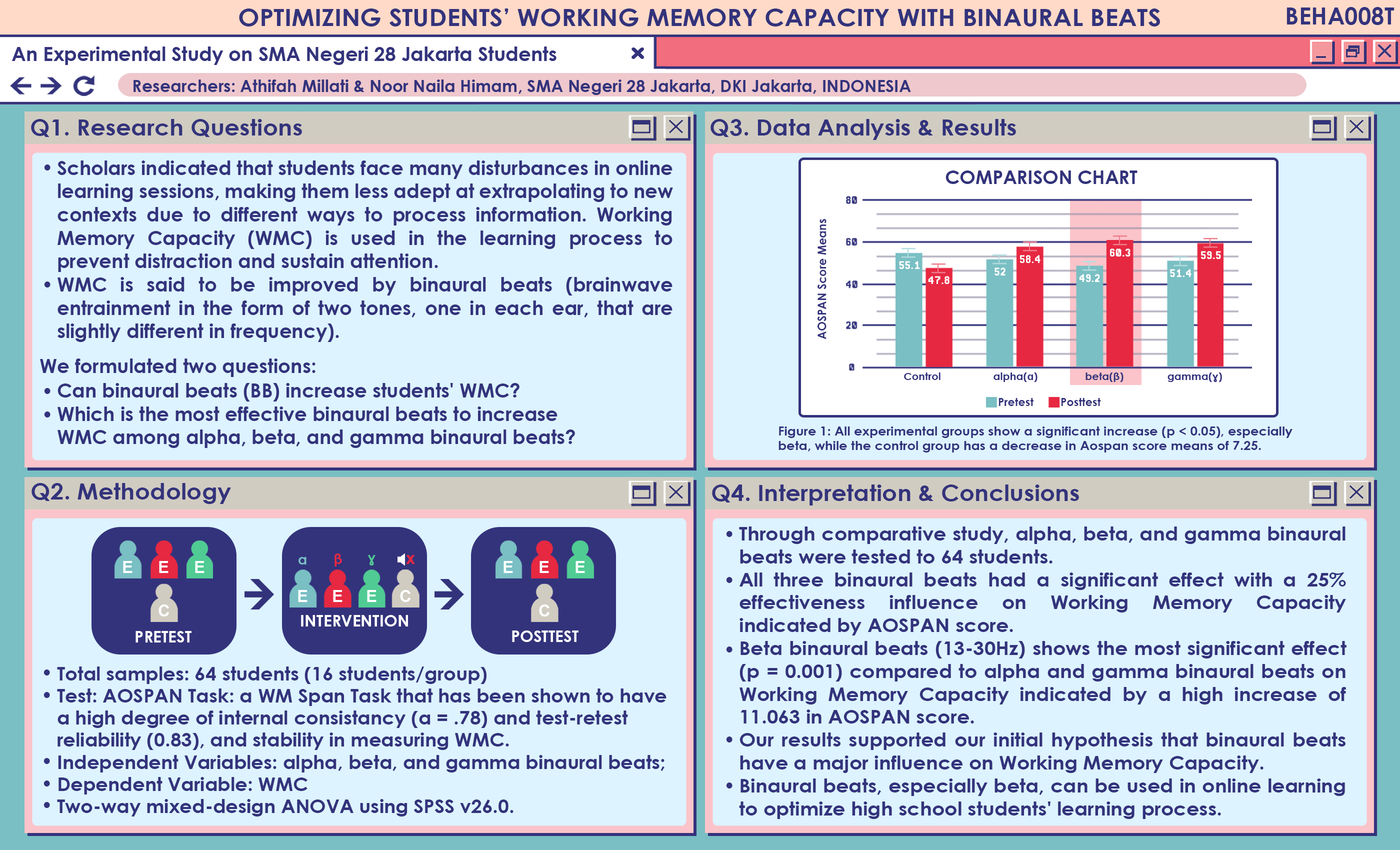
Research poster presented at Regeneron ISEF 2021 (Booth BEHA008T). Covers research questions, methodology with 64 participants across 4 groups, comparison chart of AOSPAN scores, and key conclusions about beta binaural beats' effectiveness (p = 0.001).
Non-invasive cognitive enhancement is viable
Binaural beats offer a simple, accessible method for students to optimize their working memory before study sessions, without medication or complex interventions.
Frequency matters significantly
Not all binaural beats are equally effective. Beta frequency (20 Hz) was clearly superior for working memory enhancement, highlighting the importance of frequency-specific research.
Remote experimental research is feasible
Successfully conducting a controlled experiment entirely online during the pandemic demonstrated that rigorous research can adapt to constraints without sacrificing validity.
Practical implications for education
Schools could encourage students to listen to binaural beats before learning activities to stimulate optimal brain function, especially during online learning periods.