Field Ecology
Water Quality in BC Salmon Creeks
Field ecology study comparing water quality across natural and hatchery salmon habitats
This field ecology study investigated water quality across natural salmon creeks and hatchery-managed rivers in Metro Vancouver. We measured six water quality parameters - pH, CO2, temperature, dissolved oxygen, salinity, and ammonia - at six locations including a control site (False Creek), a natural creek (Salish Creek), and four hatchery rivers. MANOVA analysis revealed significant differences across stream types, with hatchery creeks showing notably elevated ammonia levels.
Pacific salmon are a keystone species in British Columbia, but their populations face mounting pressure from habitat degradation, climate change, and water quality decline. Hatcheries play a critical role in supplementing wild populations, yet the water quality of hatchery-managed streams is often assumed rather than measured. This study systematically compared water quality between natural and hatchery environments to identify management gaps.
6
Sampling locations across Metro Vancouver
6
Water quality parameters measured
p<0.001
Significant MANOVA effect of location
Site Selection
Site Selection
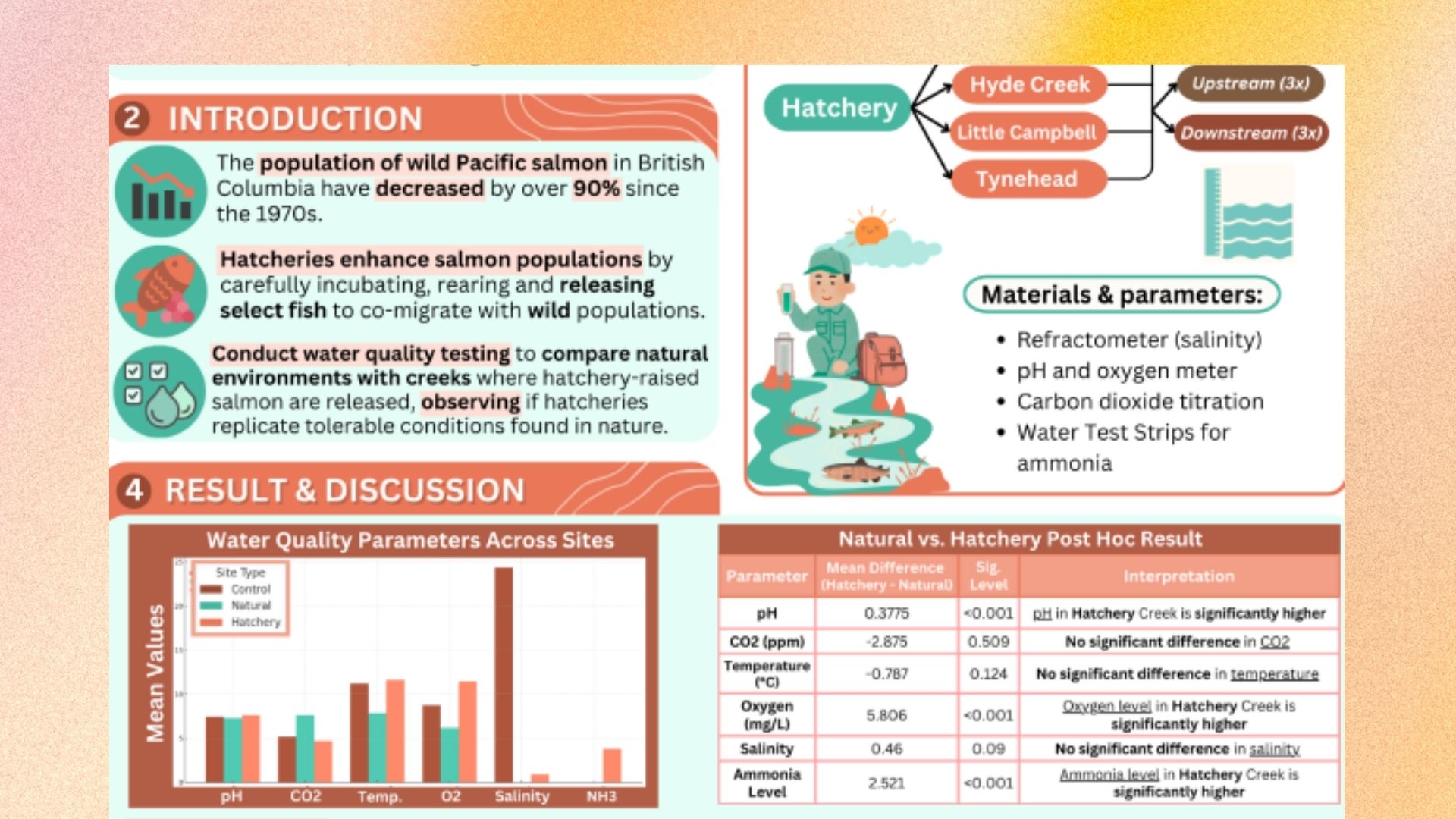
Selected six sites representing three stream types: False Creek (marine control), Salish Creek (natural freshwater), and four hatchery rivers (Hoy Creek, Hyde Creek, Little Campbell, Tynehead).
Field Sampling
Field Sampling
Collected water samples at each site with 3 replicates at both upstream and downstream points. Measured in-situ using portable instruments.
Measurements
Measurements
Recorded pH (Cergrey WQM-241), dissolved oxygen (EXTECH DO600), CO2 (titration kit), temperature, salinity (refractometer), and ammonia (Umleco test kit).
Statistical Analysis
Statistical Analysis
Ran MANOVA in IBM SPSS v30.0 to test multivariate effects of location and stream type. Used Tamhane's T2 Post-Hoc Test due to unequal variances.
Interpretation
Interpretation
Connected statistical findings to ecological processes - why hatcheries accumulate ammonia, why natural creeks have low oxygen, and implications for salmon health.
6.67 mg/L (highest)
Hatchery ammonia (Hoy Creek)
12.00 ppm (highest)
Natural creek CO2 (Salish)
6.20 mg/L (lowest)
Natural creek DO (Salish)
24.33 ppt
Control salinity (False Creek)
3.00-5.67 ppm (lowest)
Hatchery CO2 range
No significant difference (all p>0.05)
Upstream vs downstream
MANOVA: significant effect of location (p<0.001) and stream type (p<0.001) on overall water quality
Hatchery ammonia significantly higher than natural streams (mean difference = 2.521, p<0.001) - likely from decaying salmon carcasses and waste accumulation
Significant pairwise differences in pH, dissolved oxygen, and ammonia across stream types
No significant upstream vs downstream differences at any site (all p>0.05), suggesting pollution sources are localized rather than flowing downstream
Salish Creek's low dissolved oxygen (6.20 mg/L) and high CO2 (12.00 ppm) indicate organic matter remineralization and restricted water flow
Hatcheries need waste management
Elevated ammonia levels in hatchery streams indicate that decaying salmon carcasses and waste accumulate faster than natural processes can handle. Improved cleanup protocols would directly benefit salmon health and survival rates.
Natural streams need restoration
Salish Creek's critically low dissolved oxygen and high CO2 suggest nutrient pollution and restricted water flow. Restoration efforts should focus on improving circulation and reducing organic matter inputs.
Both approaches are critical
Neither hatchery management nor stream restoration alone is sufficient. Wild and hatchery salmon populations face different but equally urgent water quality challenges that require complementary strategies.
Field methods matter
Using portable instruments with 3 replicates at upstream and downstream points provided robust data while maintaining feasibility. The methodology could be replicated across BC's extensive hatchery network for systematic monitoring.